
Written by: Marisa
***Content Warning: This game contains graphic imagery and mature content that can be upsetting and may not be for all readers. Content includes gore, references to sexual assault, references to child abuse, murder, death, partial nudity, and other sensitive topics.***

In college I took a class on Victorian Horror because I’m a giant geek. Over the course of that class, I had to come up with a definition as to what horror is and how it differs from terror or simply being scared. The answer I came to was something like this—horror is a step beyond fear. It isn’t just being startled or seeing something spooky, but rather what happens when one must face something dreadful and either deal with or live with the event or knowledge that caused that anxiety, fear, or dread. It’s the difference between letting a cheap jump-scare get you in Five Nights at Freddy’s and being forced to watch yet another fan theory on Sister Location.
That being said, Death Mark does utilize terror in its atmospheric gameplay presentation, but really shines as a definitive example of what makes horror a fascinating genre through each chapter of its disturbing story and stunningly grotesque imagery. Developed by Experience Inc. and published by the MVPs of obscure localizations Aksys Games, Death Mark was initially release in Japan in 2017 and was brought to western audiences on October 31, 2018. These bad boys know how to release a horror game. It is available for the PlayStation 4, the PlayStation Vita, and the Nintendo Switch. I picked up the Vita copy because of who I am as a person, but I’m not sure if this a game you’d really want to play on the go…
The Gameplay
Death Mark is part visual novel and part point and click adventure game. If you’ve played an Ace Attorney title, I’d say they’re a little similar. Just with less finger pointing and more ghost—actually wait. Just with less finger pointing. The visual novel section is progressed by reading and making correct choices while the other segments rely on exploration and, like most point and clicks, finding, using, and combining things until you get something right. The two come together for problem solving and boss battles (Yes, boss battles. They’re both stressful and a little hilarious.), but for now I’m going to look at the two separately.
1. Visual Novel
The general set up of the story is this (Minor Spoilers) :
You the player find yourself outside a strange manor and you’re suffering from everyone’s favorite plot device, amnesia. Better go snooping around that stranger’s home for clues! Ope, there’s a talking doll inside. Ope, that lady’s dead.

What’s that creepy talking doll? She was the one with all the answers, and this tattoo I don’t remember getting is a Death Mark that will kill me and these cursed children by dawn?

Well, shoot. Looks like I’ve got to go ghost hunter on some spooky sites. I’m sure purging this one grudged-out ghost will fix everything and won’t just start a chain of semi-related ghost hunts while the characters I become attached to dip after every chapter.
(Spoiler End)
I generally try to avoid as many story spoilers as I can in my reviews. For visual novels, it gives away too much of the experience. I also fail spectacularly at conveying anything seriously, but it should be noted here that the story does get dark. I write for laughs, but the content warning should be taken seriously as this game does not pull punches and many of the ghosts you will face come with troubled pasts.
As far as visual novels go, Death Mark’s game play components are fairly simple and low stakes. There are five chapters in total, with two different endings for each chapter, then there is an epilogue with a normal and good ending. Which epilogue you get is determined by the chapter endings. If you get all good chapter endings, you get the good epilogue. If you get any bad chapter ending at all, you’re stuck with the normal ending. That’s it. No branching pathways or anything like that. If you’re someone who knows how to save your game often so you can back up if something goes wrong, then you’ll get the good epilogue no problem. And you’ll know if something goes wrong because…
Caution! Past this point, there be spoilers!

The bad chapter ends mean someone dies! Specifically, it means a partner character dies.
Death Mark gives you a choice of partners to explore areas with and judge you relentlessly as you uncover the story. Partners come and go from chapter to chapter, and that’s because you can’t have someone in the next chapter that might have died in the last. There isn’t a real reason to stress about keeping them alive though (that sounded harsher than intended…).

The story gives you every opportunity it can to keep you from messing this up. It drops hints when it can and sometimes tells you when a certain partner might be at risk if you take them with you. The story will help you keep people alive if you keep your reading comprehension up. For the less obvious choices that impact this, well, that’s what multiple save states are for. I can’t endorse multiple saves per chapter enough.
I’m not saying the other choices in this game don’t matter. I’m saying
many of them don’t matter, and the ones that do are ones you get you killed, not your partner, so they force you to go back rather than mess up your epilogue! Typically those are the Live or Die choices. Death Mark likes to be literal. Your player has a certain amount of “Soul Power” which functions like hit points. Your Soul Power decreases based on how long it takes you to make a Live or Die decision, and they take a big hit if you make bad decisions. The game ends in death if you let them hit zero. Once again, you can make good choices by knowing what’s going on in the game, and dying isn’t very punishing because you can just chose again after the Game Over.
(Spoiler End)

2. Point and Click
For exploration sections you’ll be given a starting area and a mini map you can follow to new areas. To be perfectly honest, my biggest gripe with this game is that mini- map.

Exploring starts off fine and self-explanatory. You move your flashlight which acts like a cursor around a given area to point and click on things to interact with them. You’ll find clues and items that will progress the visual narrative, and sometimes you’ll have to combine and alter items and environments you find, like filling up a water bottle or clearing an area of an obstacle. There are even hidden items for increasing your soul power. Be aware though! You can shine light on somethings that are best left in the dark. When you’re done in one place you’ll move on by moving forward, back, left, or right. This is where the mini map makes things difficult.
When you’re in your starting orientation, moving isn’t hard, but when you get turned around and need to back track, navigating can get disorienting. Sometimes you’ll see as few as two or three rooms will be visible on the map, making it hard to place exactly where you are. Some areas look different depending on if you’re going back or forward, which makes backtracking and exploration more interesting to be sure, but sometimes it’s helpful and sometimes it isn’t. This leads to remembering where you need to be, but have trouble judging how many steps you have to get back there. The game even uses this against you in a section where you have to find your way back without making any wrong turns or, you know, death happens. The minor frustrations this causes could easily be solved by allowing the play to enlarge the map when desired, even if the player had to first move to an area to view it.
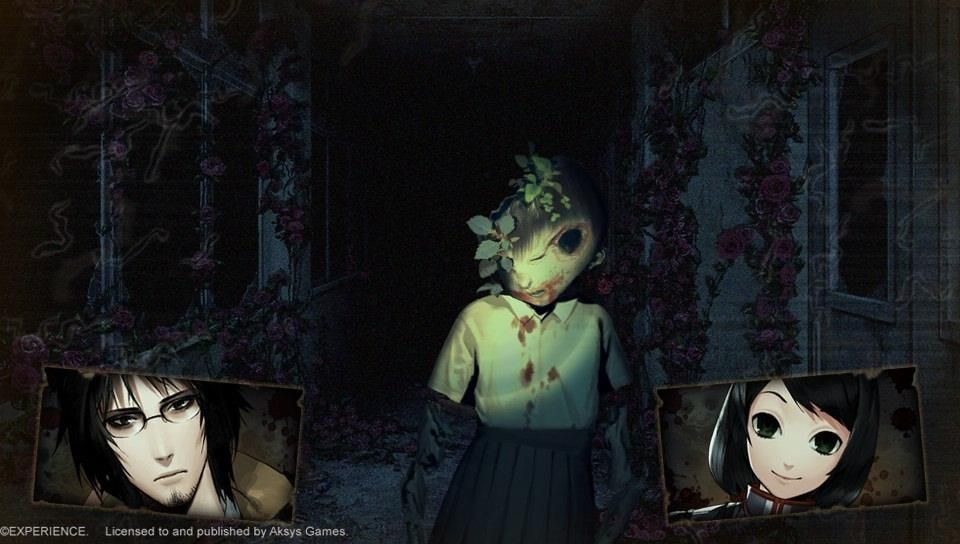
That’s the meat of it, but everything you discovered from exploration and the story will come together for boss battles. In these you will use what you’ve found and what you’ve learned to figure out what items to use together to safely bring a ghost close enough to you to beat.
Spoiler Start!
Use the wrong items and the ghost’s vengeful spirit will linger long enough to do in whatever partner you brought with you into the fray! No pressure, but maybe don’t be like me and only bring your favorites.
(Spoiler End)
Okay, without getting to far into story spoilers, describing the gameplay might make Death Mark sound pretty basic, unless perhaps you read the “is a little like an Ace Attorney game” and downloaded it on principal. I must at this point emphasize that this game is so much more than what the simple mechanics might make it seem. The game is an experience, and honestly the mechanics do what they can to allow you to have this experience making you feel clueless or stuck.
The Graphics
This is the area where Death Mark most obviously stands apart from both other horror games and visual novels. Many games can do pretty. Many games can do uncomfortable. Death Mark says, “Hold this vial of honey and blood; Imma do BOTH.” Head’s up; the imagery past this point is going to get… rough. Let’s start with something basic and mostly untroubling.

There’s a sense of beauty in the mundane that Death Mark captures in every environment. The all the art takes note of the importance of light (or lack thereof), contrast, texture and all the other details that make a good composition. The mundane aspect is important because Death Mark then takes the normal and makes it uncomfortable. Items and areas that should feel safe will be thrown wildly out of place (Those soft roses growing out of twisted skeletons in an underground bunker beneath a school with a moist bed for example…). The pictures it creates are striking but tense. Because this is a visual novel, you have to look at what’s in front of you for some time, often reading something less than pleasant to go with the image. Moving on…
(More spoilers)
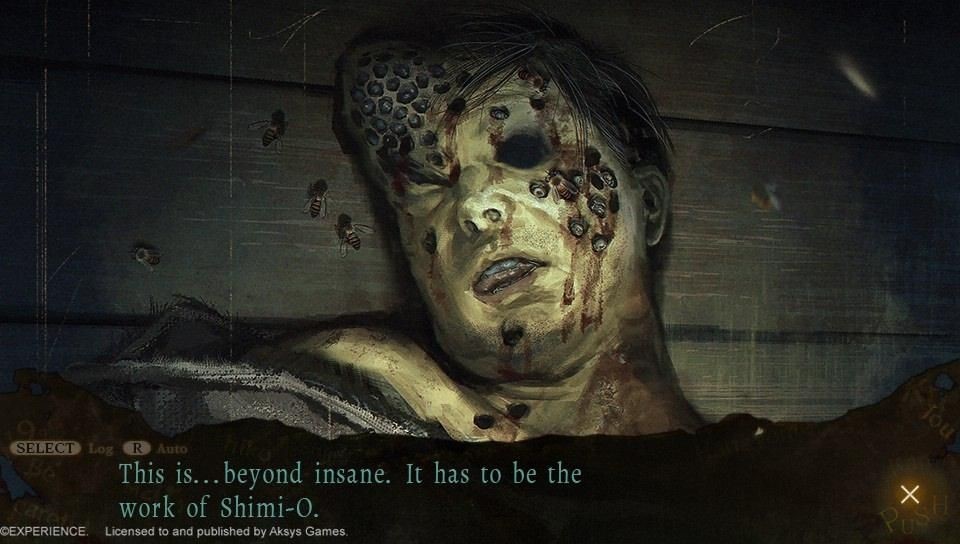
And next we have this. Look at those fuzzy bees! Look at the movement implied by the blurred bee in the upper right corner and the texture on that sack! Bethesda’s got nothing on that bag. That looks like real canvas. Man this picture is detailed when it comes to those textures!
Also, yes, that is a human beehive. Those sure are holes drilled into that man’s face. I sure did create a situation in which you had to look at that with your own two eyes. Guess this horror’s going to be stuck in the neurons of your brain forever.
You see what I was getting at with the whole horror thing involving more than just scares though, right? But don’t worry the graphics have that too. Remember that you’re holding a flashlight in game. To round out the horror with the terror, Death Mark throws plenty of ghostly sprites into the explorable environments for you to shine that light on. It’s the cherry on top to the overall presentation that will leave you in apprehension about moving your cursor around.
The Audio
Death Mark’s attention to detail isn’t just reserved for its imagery. This game utilizes sound in all the ways one might expect. There are dissonant sounds and creepy piano pieces where appropriate. Progressing any textbox triggers the sound of a soft turn of a crackling page. Important items and information sometimes come with a chime that hits all the wrong notes. All things considered though, I found I was most often more disturbed by the game’s use of near silence.
There are times when the game will have no music and just one or two ambient noises. Often those sounds will be chirping crickets. It’s not very threatening on its own, which lulls the player into a comfortable quiet for about fives seconds before THAT DANG CROW STARTS SCREECHING NOW MY VITAS BEEN THROWN FIVE FEET IN THE AIR. The near quiet allows the game to build apprehension and trigger unease as it layers in more sound effects that break the flow of the underlying calm.
The Replay and Overall Value
Considering Death Mark only has two different endings and how simple it would be to reload saves each chapter to get the good on your first try, Death Mark’s replay value doesn’t really lie in seeing how things could have gone differently like some multi-ending games. Instead, I think Death Mark is true to its genre with its replay value lying in that mood that strikes us to watch our favorite horror flicks; you can bet I’m going to drag this one out again in October or on nights that just feel good for spooks. Each chapter feels self-contained too, so one could be played every now and again without it feeling too disjointed or like it’s necessary to start over.
Death Mark is a title that should be experienced at least once if you think you can handle the content and like visual novels. The Vita copy normally runs about ten dollars cheaper than the Switch or PlayStation 4 version, and Death Mark plays like a typical handheld, so it’s great on that system. In spite of the Vita’s beautiful screen and the ten bucks it saved me, I sometimes wish I could view the horrific art on a big screen. If you don’t mind shelling out more money, grab it on the PS4 if you want trophies or the Switch if you want to open up your screen options.
Conclusion
Death Mark’s gameplay is standard for a visual novel and point and click games, but its seat in the horror genre elevate it to greater heights, making it an experience that should not be missed. Death Mark’s sense of style and attention to detail make the game’s disconcerting and brutal subjects and environments both breathtaking and horrific. This combined with the games smart audio decisions that utilize both sound and quite to create apprehension and terror place the player in an immersive horror environment. Without spoiling anything, the game’s story, like the game’s art, does not pull punches and will tell gruesome tales. This isn’t a game that just scares you; it’s a game that makes your skin crawl. Visual novels are one of the few mediums where the presentation and story of a game are capable of trumping the gameplay, and Death Mark is evidence of this. I give Death Mark an…
87 out of 100 – truly an experience.
Pros
- Everything about the art
- Flashlight shining on surprise ghosts
- Use of sound effects
- Forgiving Game Overs
- Does not rely on cheap scares
- BEES!!!
Cons
- Basic Gameplay
- Less than perfect mini map
- Bees?
 The Gaming TechLits