
By Dan D.
Odyssey is the latest in the long line of Assassin’s creed games and despite some unfortunate gameplay aspects, the occasional unresolved bug and some questionable development decisions it is still one of the better entries in the series.
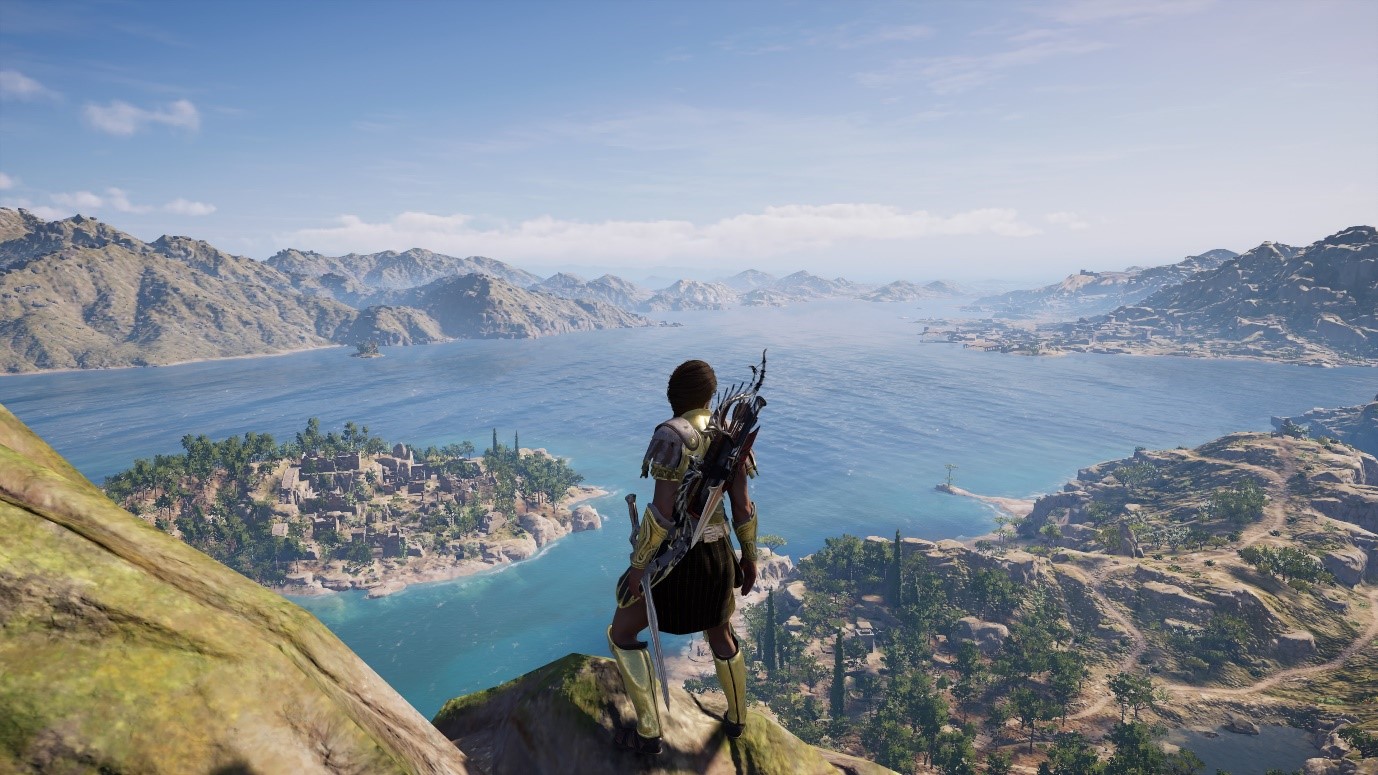
Gameplay
The first thing that I feel should be mentioned when discussing Assassin’s Creed Odyssey is that there is, in fact, a microtransaction store in the game despite it being a singleplayer experience. It should be noted that none of the items found in the store are necessary for the game to be enjoyed however there is one item that, in my experience, made the core gameplay more satisfying and that was an xp booster, this item boosts all xp earned through any means by 10% meaning that levelling requires a significant amount less grinding and less of the sometimes tedious side quests need to be completed.
The story of Assassin’s Creed Odyssey is told in much the same way as its predecessor, Assassin’s Creed Origins. This time the story is set during the height of the Peloponnesian War of Ancient Greece, making it, historically speaking, the earliest point visited in the series. For the first time in the series the player must choose the character they wish to play as for the entire playthrough, regardless of whether the player chooses Kassandra or Alexios the narrative as a whole is unaffected, so, for those concerned about having to do multiple playthroughs, rest assured the decision is a cosmetic one. This is the second game to take place prior to the foundation of the Assassin and Templar orders but like the Pre-Templar Antagonists of Assassin’s Creed Origins the enemy organisation is fundamentally the same thing. The real thematic change comes from the protagonist’s role in the world, instead of the typical, shadow-dwelling member of a hidden organisation the player must take on the role of a Misthios, a mercenary of sorts.
The story overall was interesting, full of the typical Assassin’s Creed weirdness but with a family centric story at its core. The game both starts and ends strongly, but unfortunately, the middle act felt somewhat tedious and at times was difficult to discern whether or not progress was actually being made however it was also not without its interesting story threads and developments.
The Antagonists of the game take the form of the Cult of Kosmos, like the Templars and Templar stand-ins in previous titles they are seeded throughout the game in various positions of power steering the world in their favour, the player can obtain clues to their identities through the completion of various tasks and it becomes their goal to wipe out the cult and free Greece from their influence.

The open world of the game is beyond massive, full of places to explore and the usual open world tropes Ubisoft games are so well known for (Camps, bases and climbable towers, etc). As impressive as the scale of the world is it could be considered too big, not only due to the daunting task that is getting from place but because the shear scale of the world is wasted if there is not enough interesting content developed to fill it with. Some side quest found within the world are genuinely interesting pieces of content, but the majority were rather dull and samey.
The game has its own take on systems such as the Nemesis System made popular by the Shadow of Mordor series, this comes in the form of the game’s Mercenaries.

The Mercenaries are separated into different tiers based off their reputation in the world and the player can move up that ranking by defeating higher ranking Mercenaries, each new tier reached provides additional bonuses such as discounts at blacksmiths. The Mercenaries are also linked to the game’s notoriety system, upon carrying out enough illegal actions an NPC may hire a certain number of these mercenaries to hunt player, this can make completing missions more difficult, so it is advised to be stealthy and avoid witnesses where possible. The NPC that has placed a bounty on the player’s head can be killed or paid off to clear the bounty quickly, but the bounty will expire on its own eventually over time.
Assassin’s creed Odyssey builds upon the RPG mechanics introduced in it’s more recent predecessor Origins.
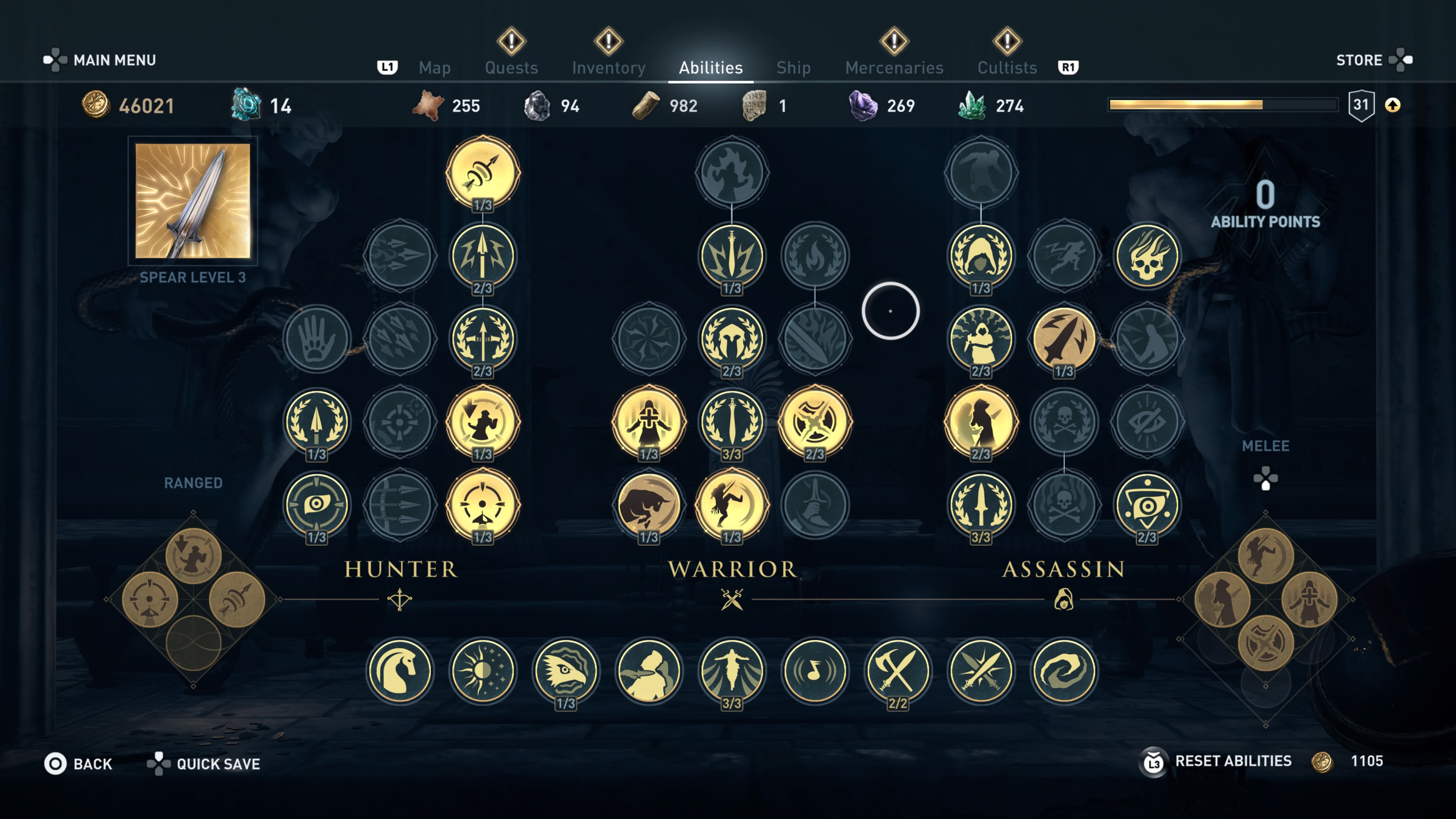
The skill trees are filled with a mixture of combat and stealth abilities as well as stat buffs for the various types of damage the player is capable of dishing out. Most skills have 3 tiers of strength and can be upgraded using skill points obtained through levelling up or through finding artefacts hidden in tombs throughout the open world.
The loot system is also similar to Origins’ system with enemies and chests dropping scalable gear of varying rarities.

Odyssey also allows players to transmogrify armour and weapons so that they may keep a style of armour they are particularly fond of even if they find a piece with better stats that is less appealing. Any gear can also be scaled up to your current character level through the use of blacksmith and crafting materials found throughout the world.
Combat is similar the system found in Origins but there are some changes. Firstly, the player no longer has access to a shield so there is far more focus on timed dodges and parrying as they are your only defensive options. The next change is that there is a greater focus on the use of abilities in combat, from shield breaking to AOE stun attacks, they charge much more quickly and are an integral part of the combat system. The new combat system is fun and pretty intuitive, but it does have its drawbacks, specifically the enemies themselves, leaning into RPG systems means that damage is heavily reliant on player level in relation to enemy levels. There are exceptions to this because elite enemies often have health bars large enough to offset level advantages and resulting in attacks feeling ineffective and fights being unnaturally drawn out.
The ship to ship combat from Assassin’s Creed Origins also makes a return with improvements over the original iteration.
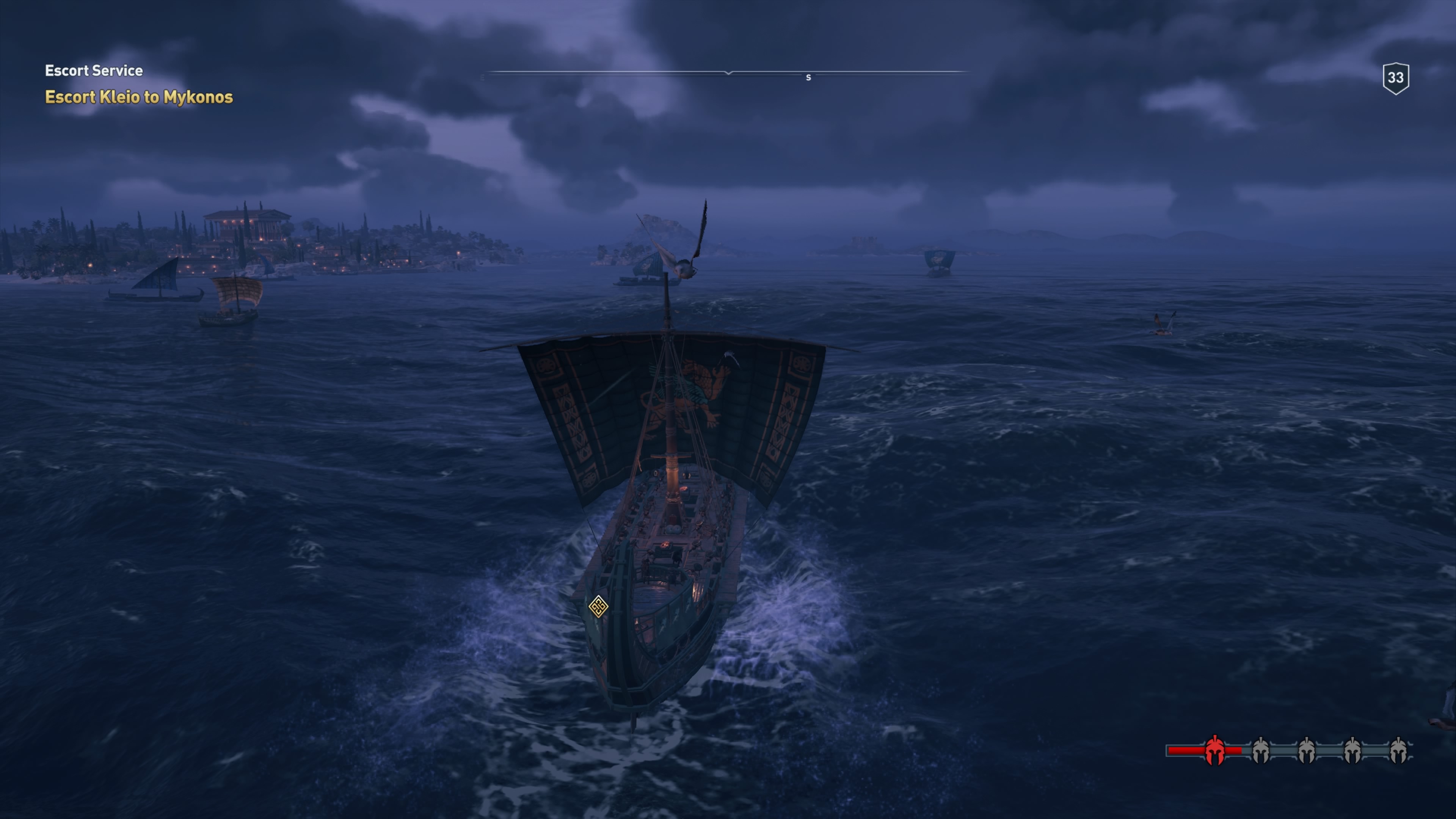
Due to the game requiring a lot of travel between islands there is a far greater focus on ship combat both in and outside of missions.
Graphics
Odyssey is overall a very pretty game, from the rolling waves of the Aegean Sea to the green forests and rocky cliffs that dot the rest of the Greek landscape.
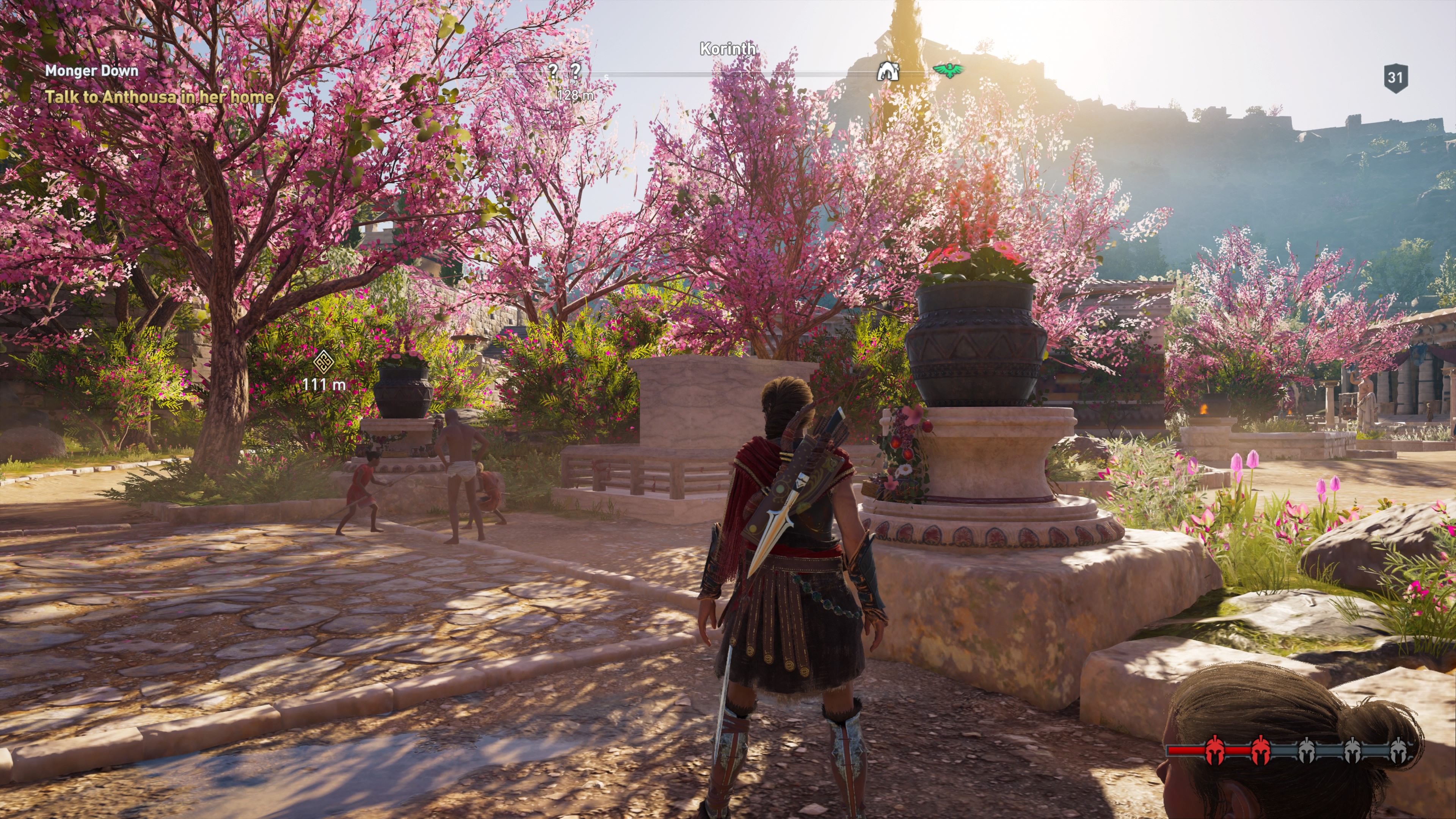
I noticed minimal pop-in texture wise but on PS4 pro the level of detail visible at a distance was quite low causing objects such as trees to noticeably pop-in while exploring.
Frame rates were mostly stable during my playthrough, but I encountered issues a couple of times during particularly demanding encounters in forts where frame rates appeared to drop into single digits, even causing the game itself to crash at times.
Audio
As with most open world games the voice acting overall is a mixed bag, particularly with the less important NPCs, some were voiced well but others sounded as though they were reading off a page without really knowing what they were saying. The voice work for both protagonists on the other hand is pretty good with Kassandra standing out as the most consistent of the two.
The soundtrack is enjoyable, with the main theme in particular being appropriately epic for the scale of the journey undertaken in the game. The crew of the player’s ship also come with a selection of sea shanties much like the crew from Assassin’s creed 4 which add a bit of life to the ship on longer voyages but I did sometimes find myself silencing after a while of listening to the same songs.
Replay potential
For completionists Assassin’s creed Odyssey is far from short of content, there is an extraordinary amount of activities to be completed between the long main story, the extensive number of side missions, the Cultists to hunt, mercenaries to challenge, bases to conquer and more. The game is almost infinitely playable depending on how invested a player is in the world and its characters. I spent roughly 60-70 hours with my playthrough of the game, completing the main campaign, many side quests and much more but found I still had enough content left by the end of my playthrough to complete to keep me busy for at least the same again.
Conclusion
Assassin’s Creed Odyssey is a big, beautiful game that sometimes falls into the same traps that many of its open world peers do, with the unnecessary “fluff” quests that can feel more like chores than tasks someone would want to accomplish. The world is at times too big and doesn’t have enough interesting content to fill it with, I can honestly say I would’ve preferred a more intimate, more densely packed setting filled with interesting content than the overly large empty space we were given.
I enjoyed the combat and the RPG mechanics that have now become an integral part of the series, I do however wish to see a decrease in the number of obscenely tanky enemies in future instalments, these enemies quickly changed from being a challenge to an annoyance as I became more proficient in the game’s combat and felt as though I was being stalled unnecessarily.
Finally, and most crucially, I fundamentally disagree with the inclusion of the microtransaction store and had I not been curious about the xp booster for the sake of this review I would not have supported it whatsoever. The over-bloated budget that would have been required due to the scale of the game and other costs could have been reigned in a little if it was not for Ubisoft’s fascination with making each new game bigger than the last, as if bigger worlds somehow equates to better games. I do not buy the industry’s “games are too expensive to make” excuse they use to justify these kinds of stores and neither should anyone else, so my recommendation is that should you decide to play the game, pretend the store is not there and enjoy the game for what it is.
Score: 75/100
+ Beautiful world to explore
+ Interesting Story
+ Fun Combat and Abilities
– Not enough interesting content to populate the map
– Balanced to promote buying boosters through MTX store
– Over-bloated enemy health bars slow down combat.
Do you agree with the thoughts expressed in this article? Have any further thoughts? Feel free to let us know down below.

 The Gaming TechLits